Friday, November 16, 2012

Undisturbed Soil Sampling on Residual Soil


FYP students worked together with their supervisor to take undisturbed sample of residual soil (so called Kenny Hill formation) at a site near Shah Alam, west of Kuala Lumpur. There was a slight difference in the texture of residual soil at the site only few meters away. One site (A) was very silty without any trace of coarse particles, while the other site (B) shows a slight inclusion of fragmented weathered coarse particles.

Undisturbed samples of 15cm x 15cm x 25cm were successfully taken by using a sort of soil nailing technique for this sampling. A wooden plate 15cm x 15cm was placed at the surface of residual soil ground, and 12 steel bars of 6mm diameter were nailed into the ground at the perimeter of the plate. Then the soil surrounding was excavated by hand shoveling. After the soil block was removed from the ground, the block was reversed in vertical position while attaching the wooden plate and then a thin layer of plaster was applied to secure the soil block from falling apart and drying during the transportation.

In addition to undisturbed samples, disturbed residual soils were taken to carry out further laboratory test, including physical property tests and triaxial strength test on compacted specimen.

The pictures below show the undisturbed sampling at the site.

 excavating undisturbed sample that surrounded by soil nails

 plastering sample for Site B

Views of Site A


Triaxial Test Apparatus Nearly Ready for Standard CD & CU Tests

Pressure supply & control system for triaxial test apparatus has been completed and also calibrations for load cell, LVDT for deformation measurement, and pressure sensor for pore water pressure measurement are completed. Thus FYP students are ready to perform standard triaxial tests on compacted residual soil, although final checking of pressure tube fittings and measurement system needs to be carried out by actually pressurizing and consolidating a soil specimen in the triaxial cell.

At the moment, a data logger which is not connected to computer is used to take all measurements. However, a system of computer controlled measurements and pressure changes using D/P air regulator needs to be introduced to perform more sophisticated triaxial tests such as a cyclic undrained triaxial test.

The picture below shows a control system and loading frame for standard triaxial test that was built solely by FYP student and technical staff of FES laboratory.

Should you be interested in these apparatus, please send your mail to utar.earthquake@gmail.com

Wednesday, October 31, 2012

Shaking Table Assembly Near Complete

Assembly of the Shaking table is nearly completed by attaching the driving megatorque motor next to the shaking table concrete base. The motor provides horizontal thrusts on shaking table. A new concrete base for the motor was built by FYP students, and the motor was placed on this new base to an exact height, in order to connect the motor driving shaft to the end of shaking table. As the shaking table is air-lifted, the horizontal thrust from the motor will provide ample energy to shake any objects horizontally on the table.

The power of shaking thrust will be examined next by first controlling the megatorque motor rotation, and a digital control system for the motor needs to be thoroughly checked. Also actual acceleration and frequency that can be achieved by the shaking table need to be measured by placing accelerometers on the table.


When the set-up of shaking table test apparatus is completed, the apparatus will be used to first determine the dynamic properties of residual soil. This apparatus has been used successfully to examine various dynamic responses of model ground at RCUSS, Kobe University, Japan and especially of examining the liquefaction problems as shown below.


If you are interested in these facilities, please contact us at utar.earthquake@gmail.com.

Wednesday, October 24, 2012

DRR Study of Kuala Lumpur City

On April 11th 2012, an earthquake of Mw8.6 occurred at off coast of Sumatra Aceh Province. The tremor was felt over a wide area in South East Asia, including Malaysia and Singapore. Large cities such as Kuala Lumpur and Singapore have many high rise buildings, and the seismic safety of these buildings needs to be carefully monitored and studied. The study of dynamic properties of ground in these large cities are extremely important for examining the seismic safety of high rise buildings.

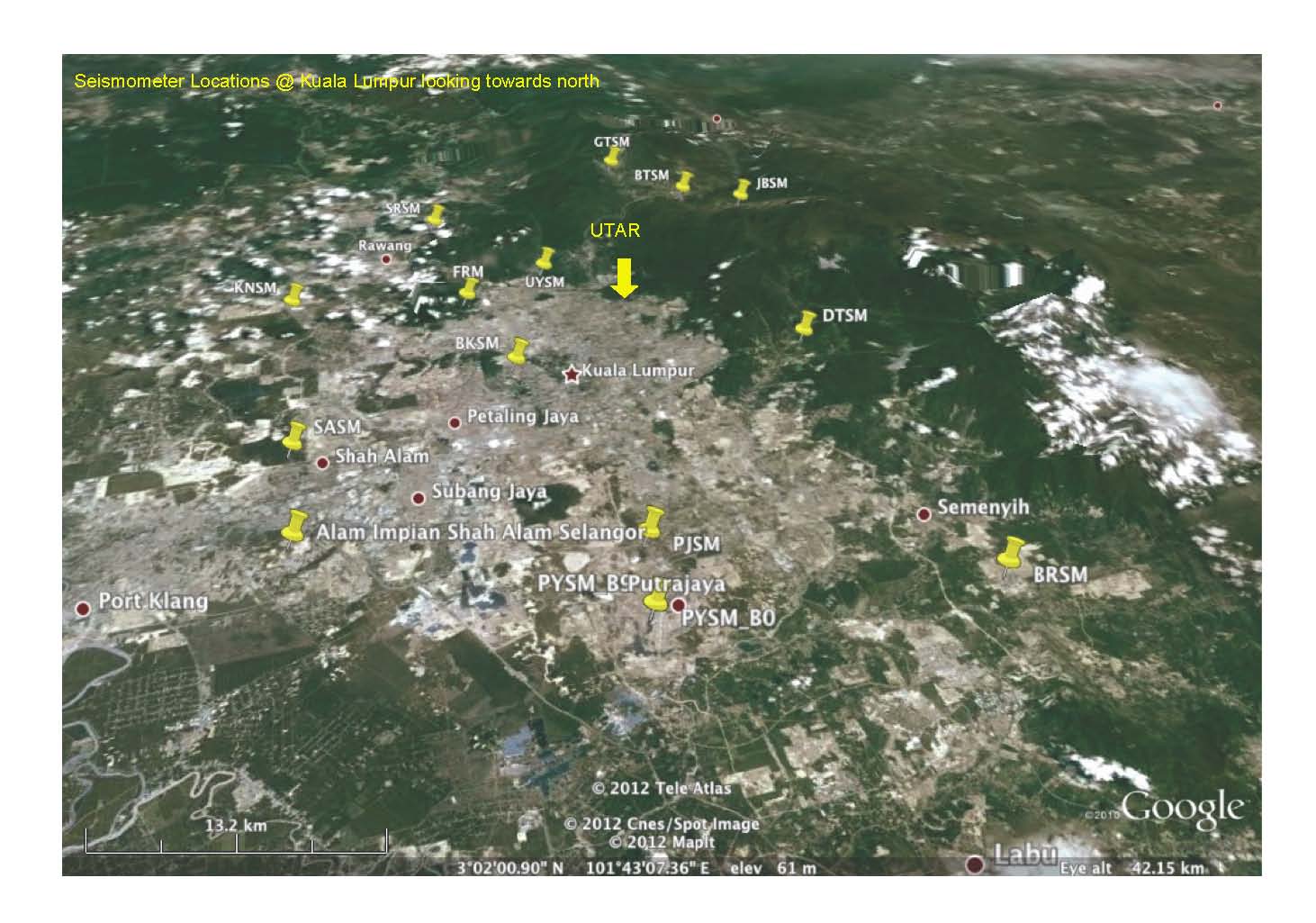
DRR (Disaster Risk Reduction) study group of UTAR Civil Engineering FYP is collecting information to study such dynamic response of buildings in Kuala Lumpur. For the first step of study, the group has visited the Meteorological Department of Malaysia (Jabatan Meteorologi Malaysia, http://www.met.gov.my/) at Petaling Jaya to learn about the seismic as well as meteorological hazard monitoring system. According to the Department, there are 14 seismic monitoring stations in Kuala Lumpur as shown below. The group will continue to gather information related to the seismic safety of Kuala Lumpur in order to promote the DRR against seismic hazards in Malaysia.

Thursday, October 18, 2012

Two more loading frames completed

Loading frames for cyclic triaxial test and hollow cylinder torsional test were completed.

The cyclic triaxial test (left) uses 10 cm diameter x 20 cm height sample for studying the small strain behaviour of residual soil under cyclic loading. Also the triaxial test apparatus is capable of measuring AE (Acoustic Emission) of soil that is used to study the yielding behaviour of soil.

The hollow cylinder torsional test (right) uses 10 cm outer diameter & 6 cm inner diameter hollow cylinder specimen with 20 cm height. The torsional force is applied by the megatorque motor and the vertical load is applied by the air cylinder above. Through a combination of torsional force and vertical load, it is possible to apply a maximum shear stress on soil specimen along any desired inclined plane from horizontal (i.e., stress rotation is also possible).

All these loading frames are produced by the machine shop of Faculty of Engineering & Science (FES)  of UTAR.

Should you have any interest on these apparatus, please contact us at utar.earthquake@gmail.com.


Thursday, October 4, 2012

First stage (air-lifting) of Shaking Table completed

 On Oct. 3rd, the set-up of base steel frame and top aluminium plate onto the concrete base has been completed. Care was taken to make sure a good horizontal level of steel frame & aluminium plate, and by installing 100 tubes at the back of the aluminium plate the Shaking Table successfully floated above the plate when we introduced pressurized air to tube. The picture below show the Shaking Table sitting on the plate.

 Next task is to connect the driving mega-torque motor to the side of concrete base so that the Shaking Table can be given a horizontal thrust to simulate the earthquake.

If you are interested in these facility, please contact "utar.earthquake@gmail.com"


Monday, October 1, 2012

Shaking Table in progress

Construction of Shaking Table for FYP @ UTAR has started and the following works are now in progress;
1) place anchor bolts to fix the base steel frame onto the concrete base,
2) prepare the air supply tube to feed in pressurized air through the base steel frame,

Within this week of Oct. 1st, the basic arrangement of Shaking Table base will be completed and a test run of air flow from the base steel frame is to be carried out to uplift the floating shaking table. After confirming a stable floating of shaking table by pressurized air, next step of constructing a motor driven horizontal thrusting  for shaking will be commenced.